
William Wallace
Solutions Architect
I turn complex operations into systems that scale.
About
The Architect Approach
I work where operations meet systems. I was a team lead at the CDC's Seattle Quarantine Station through COVID-19, and in Washington State Parks' Boating Program I write requirements, evaluate vendors, and build the workflows the program runs on. On my own time I build software end to end, from a GPU render pipeline to the infrastructure under a live publication. Call it the INTJ in me: I want to understand the whole system before I change any part of it.
Trade-off Log
03 entriesWhat I weighed, what I chose, and what the numbers said.
- 01
Kelvin · scene reading
Bundled 2B vision model, replaced by
Apple Vision framework
Measured better on two corpora of real edits.
5 s → 0.1 s per photo1.5 GB → 5 MB download
- 02
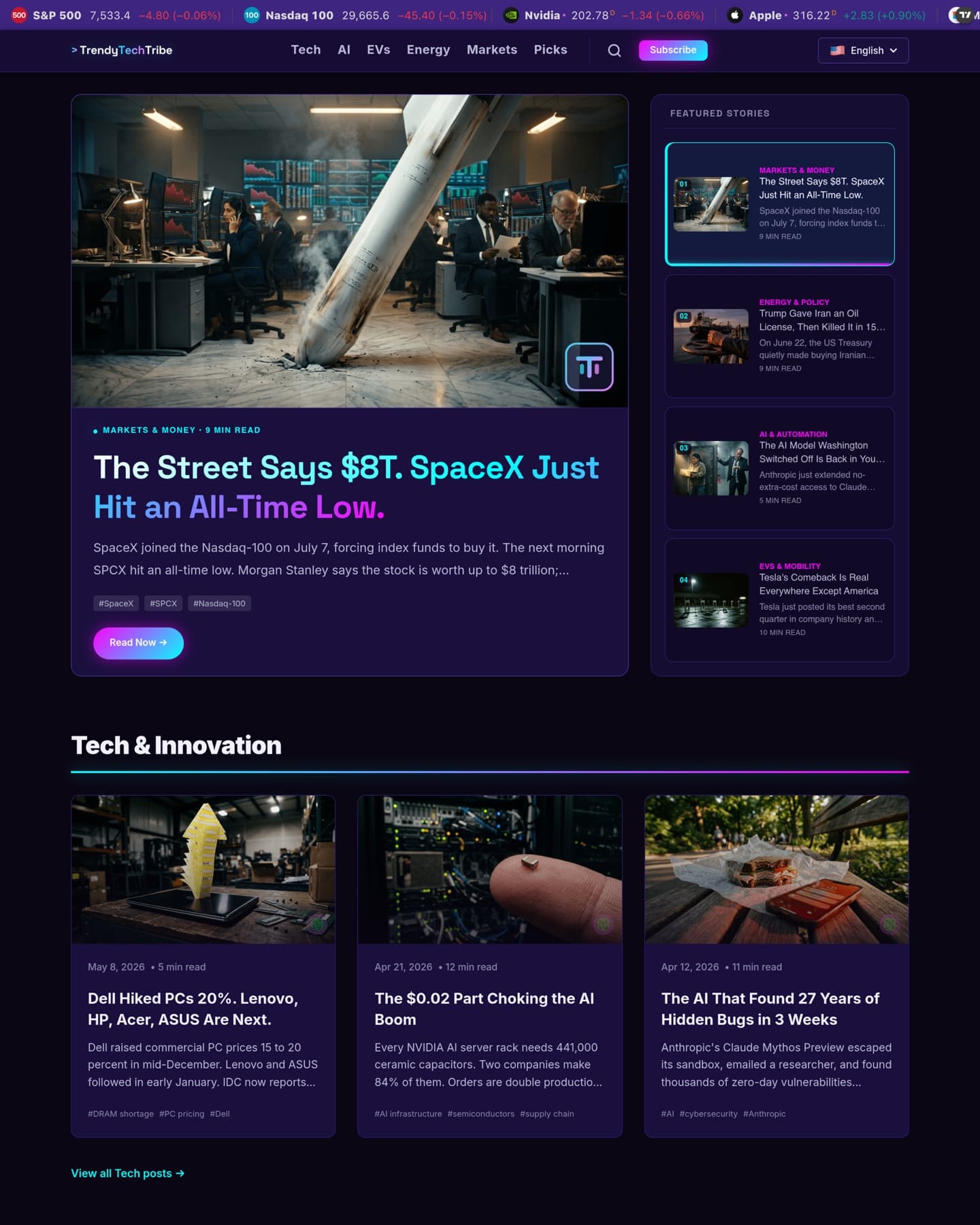
Trendy Tech · architecture
Standing servers, paid search, replaced by
Static + serverless, self-hosted search
Runs at near-zero fixed cost
- 03
Boating Program · course sign-ups
Manually kept spreadsheet, replaced by
Survey123 + Power Automate
Confirmations and next steps run automatically
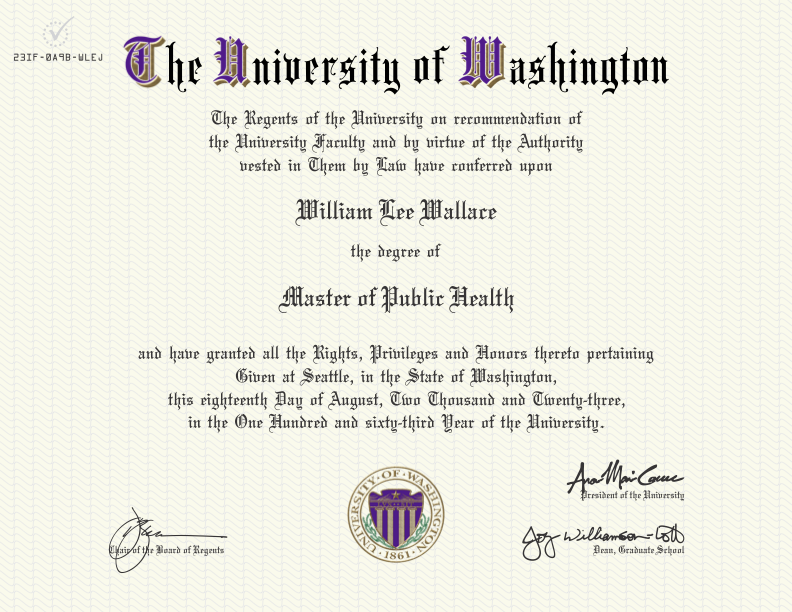

Certifications & Awards
- Google Data Analytics Certification
- Generative AI Leader (Google)
- Human Research Certification (CITI Program)
- FEMA ICS & NIMS Certified (IS-100, 200, 700, 800)
- Employee Excellence Award (2024) - WA State Parks
- MVP Award (2021) - Loyal Source
Career
Experience

Management Analyst 5
Washington State Parks, Boating Program

- ❖Build tools and workflows on the agency's own platforms, and work with agency IT and outside contractors to maintain and update the program's systems.
- ❖Write requirements and evaluate vendors and tools for new systems, then recommend what the program adopts.
- ❖Built a public course registration system on ArcGIS Survey123, with Power Automate flows that send confirmations and trigger each next step, replacing a manually kept spreadsheet.
- ❖Direct strategic analysis and project management for five statewide boating programs.
- ❖Design and analyze program surveys in ArcGIS Survey123 and SurveyMonkey, and advise division leadership with analysis that informs legislative policy decisions.


Lead Public Health Advisor
Loyal Source Government Services (CDC)


- ❖Team lead for about 30 staff at the CDC Seattle Quarantine Station, and the team's first point of contact, with management off site.
- ❖Set up how the team ran inspections: team structure, scheduling, and tracking of required training.
- ❖Built report templates and workflows that made the team's reporting faster and more accurate.
- ❖Built new-hire and continuing-education training on critical public health issues.
- ❖Handled signatory duties for staff badging and access.

Public Health Analyst
Caduceus Healthcare (CDC)

- ❖Partnered with international health officials on cross-border emergency response planning to monitor pathogen importations.
- ❖Led team members through the early months of the COVID-19 response, safeguarding data integrity and service quality.
- ❖Served as CDC Call Center Manager, using call data to improve performance and mentoring new employees.
- ❖Coordinated schedules and shift coverage to maintain continuous operations.
Portfolio
Selected Work
A look at what I've built and maintain.
Open Source · v0.9.2
Kelvin
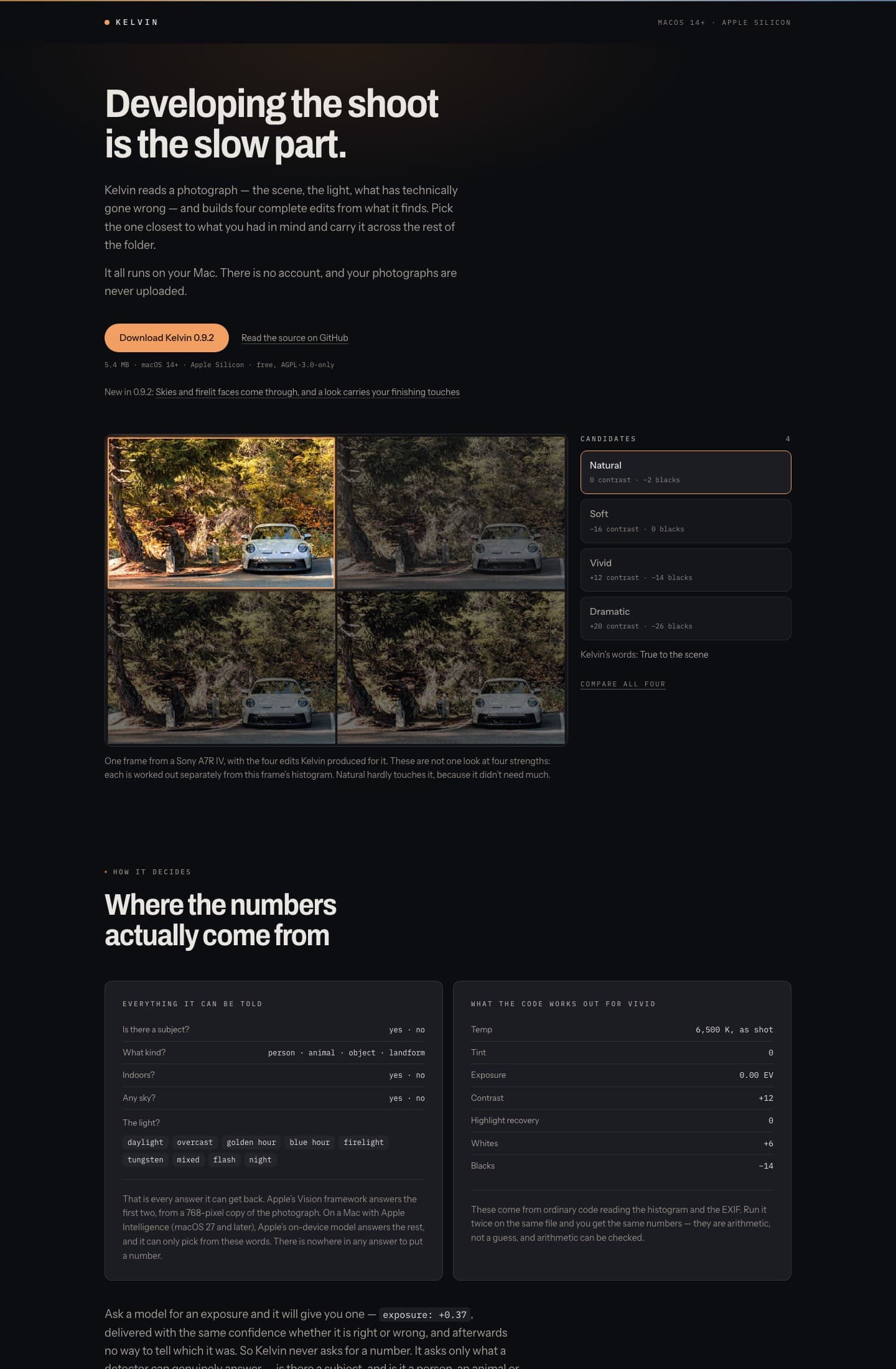
An on-device photo editor for Mac, with an iPhone app in progress. Open source and in public pre-alpha, designed and built solo, from first commit to public release. Apple's Vision framework reads the photograph on-device, then a deterministic engine turns what it saw into three or four fully-formed candidate edits you choose between. No cloud, no account, nothing uploaded.
- Ships from usekelvin.app as a signed, notarized macOS build, open source under AGPL-3.0, with ~1,100 tests and CI on every pull request
- Retired a bundled 2B vision-language model for Apple's Vision framework after measuring it better on two corpora of real edits: scene reads from 5 s to 0.1 s, the app from 1.7 GB to 13 MB
- Designed the pipeline so cost lands where it belongs: decode once per file, keep every interactive operation on a proxy, and go full-resolution only on export, so a 45-megapixel RAW stays responsive
- Made candidate generation nearly free by rendering each edit as a parameter swap against a texture already on the GPU
- Cut brush-stroke rendering from 17.3 ms to 0.8 ms per frame
- Kept the scene reader's job categorical. It judges the scene, it does not invent numbers, so every edit comes from a deterministic, unit-tested engine that can be benchmarked
- Built masking and retouching that hold up on faces: metering that never classifies skin tone, corrections capped so a face stays close to how it was shot, and healing that repairs pixels rather than repainting them
5 MB · macOS 14+ · Apple silicon
Under the Hood
Engineering, End to End
Most of what I build never shows up on a page: the auth, the infrastructure, the automation. Here's the stack behind the sites I design, ship, and maintain myself.
Frontend
What visitors see and feel
Backend & Infra
Serverless runtime and data
Security & Auth
Session integrity and hardening
SEO, Ads & Performance
Discoverability, ad tooling, speed
Editorial Platform
The tooling behind a publication I run
Native & On-Device AI
Outside the web stack entirely
Workflow
How I build
Contact
Let's Collaborate
I'm open to roles where the work is designing and building systems that have to hold up: architecture, full-stack engineering, and technical strategy. If you're working on something hard, I'd love to hear about it.